Gospel and Reflections – 22nd Sunday After Pentecost – November 9, 2025

Twenty-second Sunday after Pentecost November 9 2025

Prayer of the Day
O God, our eternal redeemer, by the presence of your Spirit you renew and direct our hearts. Keep always in our mind the end of all things and the day of judgment. Inspire us for a holy life here, and bring us to the joy of the resurrection, through Jesus Christ, our Saviour and Lord. Amen.

Gospel Reading
Luke 20:27-38 27 Some Sadducees, those who say there is no resurrection, came to [Jesus] 28 and asked him a question: “Teacher, Moses wrote for us that if a man’s brother dies leaving a wife but no children, the man shall marry the widow and raise up children for his brother. 29 Now there were seven brothers; the first married a woman and died childless; 30 then the second 31 and the third married her, and so in the same way all seven died childless. 32 Finally the woman also died. 33 In the resurrection, therefore, whose wife will the woman be? For the seven had married her.”

34 Jesus said to them, “Those who belong to this age marry and are given in marriage, 35 but those who are considered worthy of a place in that age and in the resurrection from the dead neither marry nor are given in marriage. 36 Indeed, they cannot die anymore, because they are like angels and are children of God, being children of the resurrection. 37 And the fact that the dead are raised Moses himself showed, in the story about the bush, where he speaks of the Lord as the God of Abraham, the God of Isaac, and the God of Jacob. 38 Now he is God not of the dead but of the living, for to him all of them are alive.”

Reflections and Commentary
It would be understandable to dismiss the Sadducees’ debate about the resurrection as esoteric and possibly not all that relevant. After all, the Sadducees represent one branch of Judaism that has its own take on things and they had plenty of disagreements with the likes of the Pharisees.

If you’re reading this, you’re getting a bit of bonus material that might make for too long a sermon. So onward….

Who are the Sadducees in relation to the Pharisees?

The Sadducees were the wealthy priestly class. They held that the first five books of the Hebrew scripture called the Pentateuch were the only authoritative teaching. And, as Luke reports, the Sadducees didn’t believe in the resurrection. The largest public debates were between the Sadducees (who got on find with Rome and liked the existing social order) and the Pharisees.

Pharisees were devout and were primarily ‘lay people’ with credentialed rabbis. They accepted the prophets and wisdom writings as authoritative scripture. The Pharisees did believe in the resurrection. This branch of the faith believed that a righteous life lived in contrast to the occupying rulers (and what a parade of occupiers troops through Israel’s history!) and the dominant culture was the way to honour God and the faith.

And so ??? The Sadducees aren’t asking Jesus about the resurrection because they seek comfort. They want to discredit Jesus. Here’s where setting the scene matters: Jesus and his rag tag band have marched into Jerusalem and he has taken a leaf from the prophets’ (and the reformer Ezra’s) playbook by chasing off the money changers and would be profiteers from the temple. So all the controversies about Jesus’ authority and what he’s about come to a fever pitch and he “gets it from all sides” as varied factions seek to discredit and ultimately kill him.

The “case study”: The scenario in which the brother of a childless widow marries her is called “levirate marriage” (from a latin term for brother-in-law). Such marriages were common and usually produced children, so if the woman had the misfortune of being widowed a second time, her children and late husband’s family would care for her. The question the Sadducees pose seems absurd…how often would one encounter a woman widowed seven times? So in this resurrection that they don’t believe in, the Sadducees want to know who whom the woman would be married in the after life.

Jesus’ response: Jesus takes the question at face value despite the many reasons not to. His teaching can be divided into two parts. First, the resurrected life isn’t like this one. It seems germane that the purpose of marriage in the ancient near east was to unite families as a way of building security and wealth (a social safety net, if you will). In the resurrected life, no need for such safety nets or even any other allegiances that matter in this life. Second, Jesus draws examples from the “Pentateuch” when he speaks about Moses’ encounter with God’s presence in the form of a burning bush. From the brush fire, the Lord self declares as God of Abraham, Sarah and the line of ancestors. Jesus emphasizes that the Holy voice speaks in the present tense. Resurrection versus immortality: So what happens to us when we die? today’s Gospel, Jesus doesn’t give much detail about how all of this works and maybe we aren’t really sure what we believe about what happens to us after we die. So what are the possibilities?

Nothing and that’s it The body dies and our consciousness lives on (immortality) You die…the whole kit and kaboodle and then you’re resurrected. The ancient Hebrews believed that body and soul were indivisible. So back to the ages old debate—if the self is body and ‘soul’ then what happens to that whole self after death? Resurrection?

You have to die to be resurrected. Maybe we are like we were before we were born. To quote from a decades old conversation a teacher had with his young son, “You mean (before I was born) I was no place?” Perhaps resurrection takes us from ‘no place’ to new life.

And so…. What do we mean when we say we believe in the resurrection of the body? What difference does it make anyway? Is enough that Jesus reminds us of God’s claim on us as God of the living? How does that affect how we live? How does all of this speculation inform the ways in which we love God and neighbour (and Jesus, the prophets and Moses talk a lot about that)?

Where do you find comfort and hope? Do we just ‘gut it out’ until the Sweet by and by (whatever that looks like) becomes our post earth reality? Where is God NOW? What implications does God of the living have for the life you are living right now? These questions are the ones we fuss with and live with and frankly are probably much more fraught than the silly scenario the Sadducees toss Jesus’ way.

As now, so then There are headstones in cemeteries with a verse that reads: As you are now I once was As I am now, you will eventually be.

The generations pass. We come and we go. As people of faith, we cling to scriptures and Jesus’ words that where he is we will be (John 14)—So the God of the living in whom we trust in this life is the same God that abides—-how ever it happens—in whatever happens after this life.

Posted in Uncategorized | Comments Off on Gospel and Reflections – 22nd Sunday After Pentecost – November 9, 2025

All Saints Sunday – November 2, 2025

Sunday attendance today -> 18  –  last year ->21

Sermon 🔊 (audio only)

Transcript of Gospel and Sermon

Worship Guide

Posted in Uncategorized | Comments Off on All Saints Sunday – November 2, 2025

Gospel and Reflections – All Saints – November 2, 2025

All Saints Sunday November 2, 2025

Prayer of the Day Almighty God, you have knit your people together in one communion in the mystical body of your Son, Jesus Christ our Lord. Grant us grace to follow your blessed saints in lives of faith and commitment, and to know the inexpressible joys you have prepared for those who love you, through Jesus Christ, our Saviour and Lord, who lives and reigns with you and the Holy Spirit, one God, now and forever. Amen.

Gospel: Luke 6:20-31 20 Then [Jesus] looked up at his disciples and said: “Blessed are you who are poor, for yours is the kingdom of God. 21 “Blessed are you who are hungry now, for you will be filled. “Blessed are you who weep now, for you will laugh. 22 “Blessed are you when people hate you and when they exclude you, revile you, and defame you on account of the Son of Man. 23 Rejoice on that day and leap for joy, for surely your reward is great in heaven, for that is how their ancestors treated the prophets. 24 “But woe to you who are rich, for you have received your consolation. 25 “Woe to you who are full now, for you will be hungry. “Woe to you who are laughing now, for you will mourn and weep. 26 “Woe to you when all speak well of you, for that is how their ancestors treated the false prophets.

27 “But I say to you who are listening: Love your enemies; do good to those who hate you; 28 bless those who curse you; pray for those who mistreat you. 29 If anyone strikes you on the cheek, offer the other also, and from anyone who takes away your coat do not withhold even your shirt. 30 Give to everyone who asks of you, and if anyone takes away what is yours, do not ask for it back again. 31 Do to others as you would have them do to you.”

Reflections: Who could imagine living in a world where a government defines an act of terrorism as peaceful protesting wearing an inflatable frog costume? Wha if such “shenanigans” were a way of loving one’s enemies?

I would say this next bit in “all caps” or shouting- When Jesus commands, yes commands, that everyone within earshot to love their enemies he is not condoning abuse. He is most certainly NOT telling those abused to endure because they will find relief in the afterlife. What is Jesus saying to the powerless and poor?

What is Jesus saying about a system where it is legal for soldiers to confiscate your coat or to slap you just because they feel like it?

Turning the other cheek is the moral equivalent to the peaceful protest wearing an inflatable frog costume. Imagine the shame, if folk even have that capacity anymore, a thug would feel for picking on a puffy little t rex or a frog or for that matter an 85 year old grandmother or a pastor wearing her clergy collar?

Loving one’s enemy is not the same as liking them. Love is known for seeking what is best for the sake of the beloved—maybe that means lampooning boorish brutality and abusive in hopes the abuser might come to their senses. Maybe objecting to injustice could simultaneously bring some sort of redemption for the oppressor and relief for the oppressed. And there, dear siblings is the very heart of what some call liberation theology —where EVERYONE is liberated because Jesus overcomes death and the grave and opens for everyone the possibility of liberation.

Our world lives by a garishly tarnished Golden Rule: Them with the gold make the rules. Such rule enshrines abuse, oppression, retaliation and revenge. Jesus confronts all of that and calls us to do the same…without vitriol or violence or retribution campaigns.

Jesus calls us to be different. Fun fact: the word saint connotes a sense of being set apart as a people of contrast— the world needs quiet saints offering kindness in the most everyday ways, the world needs saintly wagers of peace and maybe even a few people among us daring enough to put on that inflatable frog costume.

Posted in Uncategorized | Comments Off on Gospel and Reflections – All Saints – November 2, 2025

Clocks Go back One Hour This Weekend – November 2, 2025

Posted in Uncategorized | Comments Off on Clocks Go back One Hour This Weekend – November 2, 2025

Reformation Sunday – October 26, 2025

Sunday attendance today -> 14  –  last year -> 18

Sermon 🔉 (audio only)

Transcript of Gospel and Sermon

Worship Guide

Posted in Uncategorized | Comments Off on Reformation Sunday – October 26, 2025

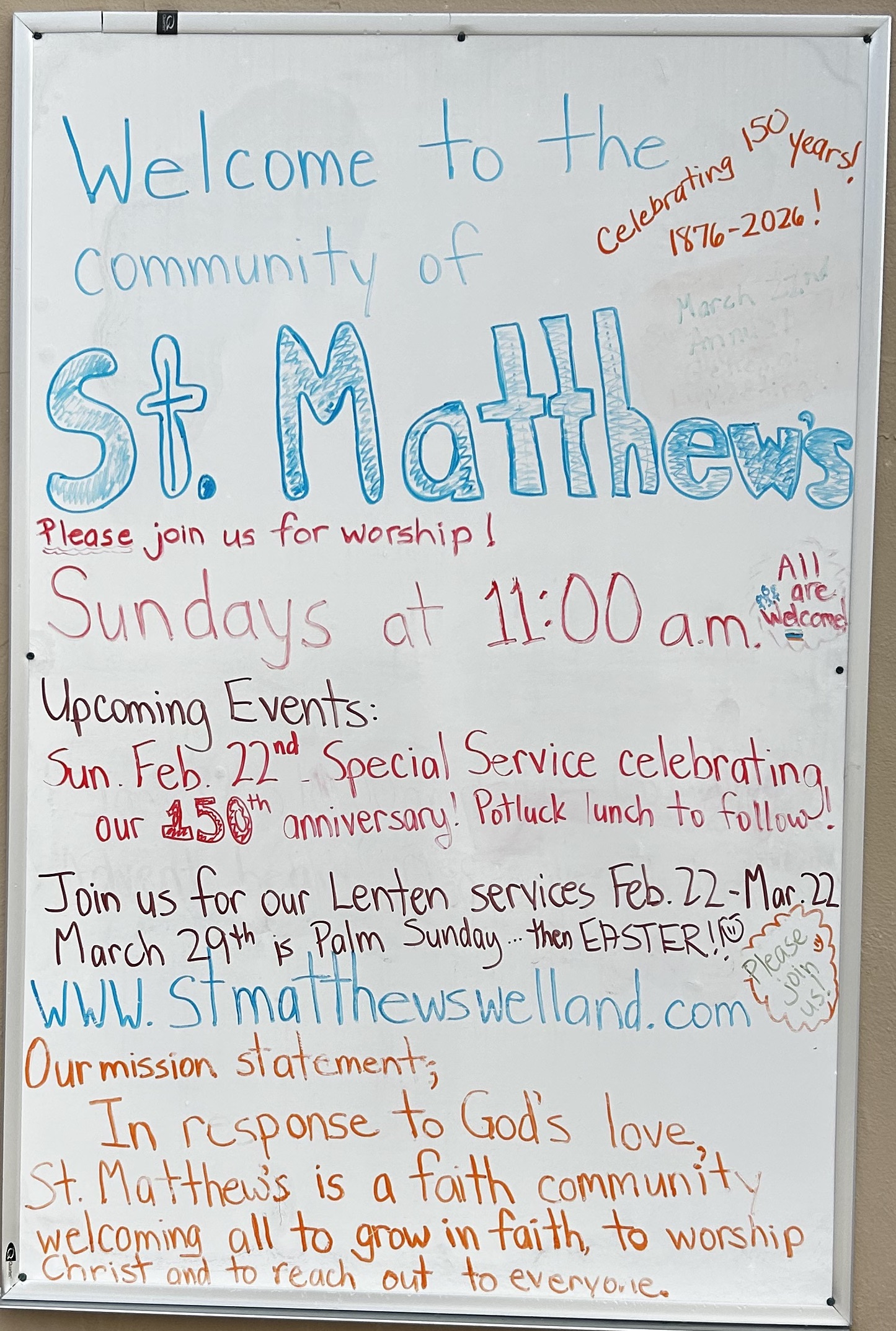
St. Matthew’s Communty White Board Update – October 20, 2025

Posted in Uncategorized | Comments Off on St. Matthew’s Communty White Board Update – October 20, 2025

19th Sunday After Pentecost – October 19, 2025

Sunday attendance today 13 – last year 14

Sermon 🔉 (audio only)

Transcript of Gospel and Sermon (Pdf text format)

Worship Guide

Posted in Uncategorized | Comments Off on 19th Sunday After Pentecost – October 19, 2025

Gospel and Reflections – 19th Sunday After Pentecost – October 19, 2025

Nineteenth Sunday after Pentecost.

October 19, 2025 Prayer of the Day
O Lord God, tireless guardian of your people, you are always ready to hear our cries. Teach us to rely day and night on your care. Inspire us to seek your enduring justice for all this suffering world, through Jesus Christ, our Saviour and Lord. Amen.

Gospel: Luke 18:1-8
1 Then Jesus told them a parable about their need to pray always and not to lose heart. 2 He said, “In a certain city there was a judge who neither feared God nor had respect for people. 3 In that city there was a widow who kept coming to him and saying, ‘Grant me justice against my accuser.’ 4 For a while he refused, but later he said to himself, ‘Though I have no fear of God and no respect for anyone, 5 yet because this widow keeps bothering me, I will grant her justice, so that she may not wear me out by continually coming.’ ” 6 And the Lord said, “Listen to what the unjust judge says. 7 And will not God grant justice to his chosen ones who cry to him day and night? Will he delay long in helping them? 8 I tell you, he will quickly grant justice to them. And yet, when the Son of Man comes, will he find faith on earth?”

Reflections: Exhortations to pray might feel too burdensome when the prayers just don’t come. Retired U.S. Bishop H. George Anderson recalls his experience of being widowed and sitting in the congregation, too sad and worn down to pray. He told editors of the Lutheran Magazine that he drew strength from the prayers of others and for a long while he found solace sitting among people praying when he could not.

For millennia monastic communities would pray into the night and in the early hours believing these prayers supported the world. Those praying trusted that their prayers sustained nursing mothers comforting fussy babies, calmed anxious souls for whom sleep would not come, comforted those who were dying and protected night workers seeing to public safety and the common good.

Sometimes just knowing others are praying does a weary soul good. Studies like one conducted decades ago by the journal of Spirituality and Health suggest that patients who knew someone was praying for them fared better during hospitalizations and surgeries.

So if you’re praying, remember others who simply can’t. If you feel you’ve lost heart and can’t pray, may you find comfort knowing others are praying in your stead and for your sake—the scripture says God’s Spirit prays for us when our words fail.

Long ago, I asked a devout person about the pattern she followed praying especially because she was homebound. Gwen prayed the Lord’s Prayer every morning again at noon and finally as she prepared to sleep. I can’t imagine gentle Gwendolyn being vexing in her consistent prayers like the woman in the parable… who if you read the literal translation…. was giving the unrighteous judge a black eye with all of her appeals for justice.

What would happen if faith communities prayed the Lord’s Prayer with Gwen’s consistency and the widow’s urgency? Might we be the ones changed somehow? What might happen to us as we discover the Lord’s Prayer is truly anti-empire?

How might our worldview shift when we pray with the widow’s insistence that God enables us to live under God’s governance, that God for provides daily bread and helps in our relationships and that God alone can truly deliver us from evil?

To lose heart is to lose hope; we pray the loss isn’t permanent! May prayer kindle hope…hope that is said to have two daughters; anger at injustice and inhumanity and courage to be just and humane. May communities that embody and share hope continue to be the answered prayer for the rest of us. Amen.

Posted in Uncategorized | Comments Off on Gospel and Reflections – 19th Sunday After Pentecost – October 19, 2025

Thanksgiving Sunday – October 12, 2025

Sunday Attendance  today 16 – last year 21

Sermon 🔉 (audio only)

Transcript of  Sermon (PDF format)

Worship Guide

Posted in Uncategorized | Comments Off on Thanksgiving Sunday – October 12, 2025

Gospel and Reflections – 18th Sunday After Pentecost – October 12, 2025

Eighteenth Sunday after Pentecost October 12, 2025

Prayer of the Day Almighty and most merciful God, your bountiful goodness fills all creation. Keep us safe from all that may hurt us, that, whole and well in body and spirit, we may with grateful hearts accomplish all that you would have us do, through Jesus Christ, our Saviour and Lord. Amen.

Gospel: Luke 17:11-19 11 On the way to Jerusalem Jesus was going through the region between Samaria and Galilee. 12 As he entered a village, ten men with a skin disease approached him. Keeping their distance, 13 they called out, saying, “Jesus, Master, have mercy on us!” 14 When he saw them, he said to them, “Go and show yourselves to the priests.” And as they went, they were made clean. 15 Then one of them, when he saw that he was healed, turned back, praising God with a loud voice. 16 He prostrated himself at Jesus’s feet and thanked him. And he was a Samaritan. 17 Then Jesus asked, “Were not ten made clean? So where are the other nine? 18 Did none of them return to give glory to God except this foreigner?” 19 Then he said to him, “Get up and go on your way; your faith has made you well.

Reflections:If Jesus’ words never strike me as strange, if Jesus’ words never cause me some sense of unrest, if Jesus’ words never trouble me, then I can be sure of one thing: I can be sure that I am missing something important. Professor Eric Baretto, Princeton Theological Seminary, NJ, US

True as these words are for me, I am merely repeating a more eloquent statement of my experience offered by Professor Eric Baretto from Princeton Seminary in the U.S. Words that churn up things for us include…

a region between, as in the margins or a border land

lepers—-even St. Francis was creeped out by leprosy before his spiritual awakening

Samaritan—-

and finally, Did none of them return to give glory to God except this foreigner?”

We find Jesus walking among people exiled because of a skin condition thought to be contagious—they have been deported to a border place neither here nor there and consigned to a life belonging nowhere. In this land for nobody, God shows up and heals everyone—including a Samaritan which means this one is doubly outcast. And Jesus marvels at his faith even calling him a foreigner. Takes one to know one.

Jesus’ history was as a refugee fleeing Herod’s infanticide. Jesus’ ancestral tradition harks to prophets reminding the returned exiles to extend hospitality to those now displaced. Jesus’s heritage to the time of Moses insists we remember our own wilderness wandering and displacement and that we exercise empathy toward the outsider.

On a Thanksgiving weekend, if you’re looking for things to be thankful for, consider rejoicing that God shows up in the no-where places and brings healing to those living on the margins. Rejoice that God’s table, as Jesus demonstrates in this nowhere land is one that extends both in size and in breadth of those invited to it.

If you’re looking for a grateful response, consider committing what some purported Christians denounce as sinful; lean into empathy for those who are displaced, shut out or marginalized for any reason. Yes, exercise that sinful empathy and if I might riff on Luther’s words, when you do, ‘sin boldly’ and believe more boldly still in God’s scandalous forays into the margins where God heals and embraces indiscriminately and lavishly. Thanks be to God.

Posted in Uncategorized | Comments Off on Gospel and Reflections – 18th Sunday After Pentecost – October 12, 2025