
Attendance today ->8 – last year-> n/a
Sermon 🔉 (audio only)
Transcript of Gospel and Sermon

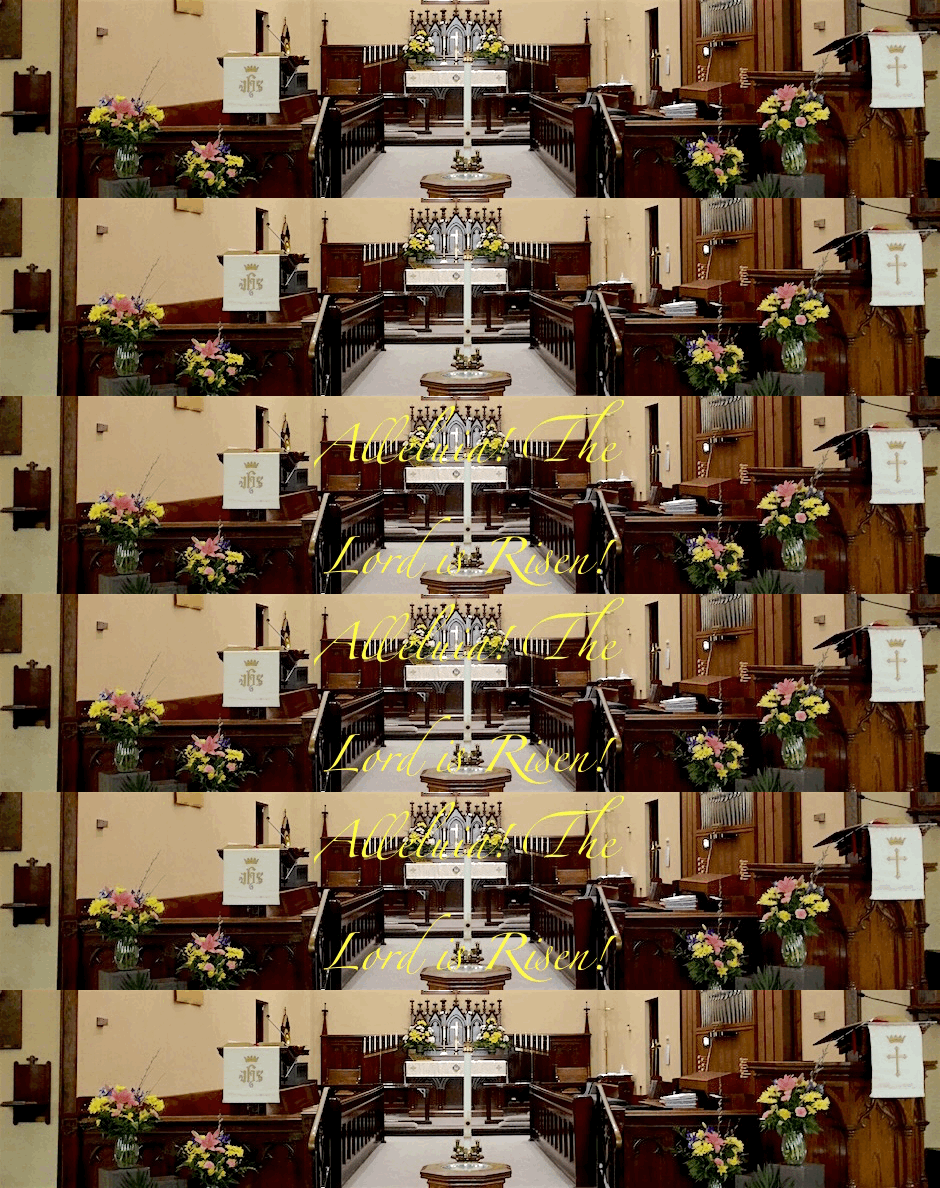
FIFTH SUNDAY AFTER EPIPHANY- February 8, 2026
Prayer of the Day Lord God, with endless mercy you receive the prayers of all who call upon you. By your Spirit show us the things we ought to do, and give us the grace and power to do them, through Jesus Christ, our Saviour and Lord. Amen.
“This is my Son, my Beloved with whom I am well pleased” Matthew 3:17 Gospel: Matthew 5:13-20 [Jesus said:]
13 “You are the salt of the earth, but if salt has lost its taste, how can its saltiness be restored? It is no longer good for anything but is thrown out and trampled under foot.
14 “You are the light of the world. A city built on a hill cannot be hid. 15 People do not light a lamp and put it under the bushel basket; rather, they put it on the lampstand, and it gives light to all in the house. 16 In the same way, let your light shine before others, so that they may see your good works and give glory to your Father in heaven.
17 “Do not think that I have come to abolish the Law or the Prophets; I have come not to abolish but to fulfill. 18 For truly I tell you, until heaven and earth pass away, not one letter, not one stroke of a letter, will pass from the law until all is accomplished. 19 Therefore, whoever breaks one of the least of these commandments and teaches others to do the same will be called least in the kingdom of heaven, but whoever does them and teaches them will be called great in the kingdom of heaven. 20 For I tell you, unless your righteousness exceeds that of the scribes and Pharisees, you will never enter the kingdom of heaven.”
Sermon: Jesus—the Beloved in whom God is well pleased—lives on the fringes of society. It’s a good bet that the church has followed him there sometimes. In each generation we’re called to follow him there again.
Jesus grammar matters when he speaks to a gathering of everyday people who also live on the margins—“All you all” ….are ALREADY light in and for the world.”
No picking and choosing who might qualify. No stipulation about getting your act together.
Many who hear Jesus declare that they are light for the world more likely felt like they were invisible. Or worse, that they are targeted as prey for a greedy empire.
People who first hear Matthew’s retelling of Jesus’ words are displaced people. The occupiers have destroyed their centre of worship and locus of community life. In the Beatitudes and in this part of the Sermon on the Mount, Jesus speaks to those for whom the system either doesn’t work, or it actively works against them. Jesus tells them ‘you are seen, you are known, and you are loved…by God!
What’s more….we aren’t defined by the power brokers who seek to brand us as loyal subjects or target audiences with credit cards at the ready. Jesus announces God’s rule and realm of justice and mercy is breaking through like pin points of light in a night sky. Except the light is here….as Jesus tells a crowd of everyday people—You…all of you ARE the light of the world.
Most of today’s church around the world lives on the margins. In many places it always has. “On the margins” may well be exactly where we need to be because that’s where “the beloved Son” chooses to live his life.
Some forty years ago, a woman from a church group I was part of returned from a mission trip to Central America. She met Christians who gathered in house churches and open air spaces. Anne recalls “I thought I was going as a missionary but these people, the poorest of the poor, were so generous and joyous. They made the Gospel real for me.” Anne concluded places wealthy and powerful as North America are actually a mission field.
These days some who identify as Christian believe that God intends for them to be the primary if not the sole light bearers—You might have read about the “Seven Mountains of Dominion” or about the New Apostolic Order calling for Christians to occupy and control society’s major institutions including media, courts, government, schools, and medicine.
These so-called “Dominionists” take offense at the Beatitudes and ridicule anyone who strives to live by them as “woke” and “weak”.
Clearly the agenda insisting that religion dominates society collides with the Beatitudes. Unexpectedly, if not palpably, such a clash connects Jesus’ words announcing that everyday people are light of the world to His warnings about people breaking commandments and teaching others to do the same.
We shine our light not by cranking up klieg lights and blasting them into peoples’ faces. Instead as one writer about Good News Sharing, the Dutch scholar Stefan Paas expresses it “. . . only if people do not feel threatened by an institutional grasp for power by Christians will they feel free to appreciate what Christians have to tell.”
Jesus calls us out to the margins and we see God’s light there. And as our baptism vows remind us, We let our light shine so others might see our good works and glorify our Father in Heaven.

Click HERE to view today’s worship service (Third Sunday After Epiphany) on their Facebook Live page.
Second Sunday after Epiphany January 18, 2026
Prayer of the Day
Holy God, our strength and our redeemer, by your Spirit hold us forever, that through your grace we may worship you and faithfully serve you, follow you and joyfully find you, through Jesus Christ, our Saviour and Lord. Amen.
Words to ponder during time after Epiphany:“This is my Son, the beloved with whom I am well pleased” Matthew 3:17
Gospel: John 1:29-42
29 [John the Baptist] saw Jesus coming toward him and declared, “Here is the Lamb of God who takes away the sin of the world!30 This is he of whom I said, ‘After me comes a man who ranks ahead of me because he was before me.’ 31 I myself did not know him, but I came baptizing with water for this reason, that he might be revealed to Israel.” 32 And John testified, “I saw the Spirit descending from heaven like a dove, and it remained on him. 33 I myself did not know him, but the one who sent me to baptize with water said to me, ‘He on whom you see the Spirit descend and remain is the one who baptizes with the Holy Spirit.’ 34 And I myself have seen and have testified that this is the Chosen One.”
35 The next day John again was standing with two of his disciples, 36 and as he watched Jesus walk by he exclaimed, “Look, here is the Lamb of God!” 37 The two disciples heard him say this, and they followed Jesus. 38 When Jesus turned and saw them following, he said to them, “What are you looking for?” They said to him, “Rabbi” (which translated means Teacher), “where are you staying?” 39 He said to them, “Come and see.” They came and saw where he was staying, and they remained with him that day. It was about four o’clock in the afternoon. 40 One of the two who heard John speak and followed him was Andrew, Simon Peter’s brother. 41 He first found his brother Simon and said to him, “We have found the Messiah” (which is translated Anointed). 42 He brought Simon to Jesus, who looked at him and said, “You are Simon son of John. You are to be called Cephas” (which is translated Peter).
A few thoughts as Sunday approaches…. Somewhere along the way, we got it into our noggins that the four Gospels are simply four re-tellings of the story of Jesus; God among us. Careful readers notice that timelines didn’t always match up or even that some events were included in one Gospel and omitted in others. These observations have led to valiant and misdirected efforts to figure out how to ‘harmonize’ all the Gospels so every detail ‘dovetails’ with all others. These attempts to “harmonize” lead to an incomplete picture of Jesus shown to us in scripture.
To cut this little history lesson short, suffice it to say that when we read from Matthew one week and John the next, we really need to let each Gospel speak its own truth while holding the others alongside. John’s Gospel is replete with words that hold many layers of meaning. To speak about the “Lamb of God” is to look at many ways Jesus is the lamb of God. To hear John proclaim that Jesus takes away the sin (singular) of the world (another word with several meanings)requires that we pay attention to what John means by “sin”. We get there. by paying attention to a word John’s Gospel uses forty times; a word often translated as ‘abide’ or remain (inexplicably I feel compelled to write the transliterated word from the Greek meno).
Abiding and remaining are all about relationship. At Jesus baptism, Spirit descends and remains. The first would-be disciples ask Jesus where he is staying (abiding or remaining). Instead of providing GPS coordinates or a street address Jesus invites them to come and see where he remains, how he lives and what he stands for.
Throughout John’s Gospel, Jesus speaks repeatedly to his followers about ‘remaining’ and abiding. Even as he speaks of his life’s end and assures his followers that he goes to prepare a place beyond this life; a place he where promises he will be with us and we with him (guess which word John uses here!).
This word study is meant to lead us right back to John bearing witness that Jesus is Lamb of God who takes away the sin of the world. Jesus confronts anything and everything that would preclude the relationship (abiding and remaining) between God and humanity. This understanding of “sin” inevitably brings us to the way John’s Gospel uses the word “belief”. The word is always a verb…not a one and done verbal declaration or document signing about what we think we know or accept as true. Belief in John’s Gospel is all about living in relationship. Remember the famous verse about “whoever believes has everlasting life” (yet another phrase with multiple layers of meaning)? Remember the beginning of John’s Gospel that declares that the essence of God becomes human and makes his home among us?
Another way of taking John’s Gospel on its own terms is to recall when it was written and to whom. The other three Gospels had already been in circulation by the time John’s Gospel is told and later written down. John’s words are directed to Jewish folk who believed that God’s ancient promises were embodied in Jesus— their belief created estrangement from their own faith tradition and community. So John speaks to a people who likely felt lost, disconnected and dispossessed. His words about relationship abide, remain, belief) likely resonated in particular ways with this community. Imagine living as these these folk did and hearing someone recount John the Baptizer(some scholars like to note he is also John the Witness) say, “See there! That’s the one! That’s God’s incarnate self among us, with us and for us…all of us!”
A few things to ponder…. How are we living witnesses to God among us and in the world? What does it mean for us to believe? How does the church and how do individuals “remain/abide” with Jesus? What does Jesus’ abiding and remaining with us know look like?


 St. Matthew's Evangelical Lutheran Church, Welland, Ontario, Canada
Love it Rona. Thanks On Sat, Mar 7, 2026, 11:20 a.m. St. Matthew's Evangelical Lutheran Church,